Perhaps no period of American history has been taught—or remembered—more inaccurately than Reconstruction, the post-Civil War effort to restore the Southern states and determine the status of four million formerly enslaved people.
For much of the twentieth century, the dominant interpretation came from William A. Dunning, a Columbia University historian whose work reflected conservative White Southern attitudes. According to the Dunning School, Abraham Lincoln envisioned a generous restoration policy, but Radical Republicans in Congress imposed a vindictive alternative after his assassination. Corrupt Northern “carpetbaggers” and Southern “scalawags” then manipulated supposedly ignorant Black voters and misgoverned the Southern states.
That was the version I learned in school during the 1960s, and I had no reason to question it.
In 1956, John F. Kennedy repeated this discredited interpretation in the Pulitzer Prize-winning book Profiles in Courage. Kennedy described Reconstruction as “a black nightmare the South never could forget” and presented Mississippi governor Adelbert Ames as the embodiment of “carpetbag rule.” Ames, a former United States Army general from Maine, had been elected largely by Black voters and tried to protect their political rights against organized White violence.
Opposing interpretations existed, most notably the one advanced by W. E. B. Du Bois. In Black Reconstruction in America, published in 1935, Du Bois rejected the claim that ignorant Black voters had ruined Reconstruction. Those governments, he wrote, established public-school systems, enacted social legislation, and extended political participation to people who had previously been denied any voice in government. Du Bois’s interpretation gained little traction within the predominantly White historical profession.
White academic attitudes toward Reconstruction began to change after World War II and shifted more rapidly during the civil-rights movement. Black veterans returned from the war demanding the rights for which they had fought. Then Brown v. Board of Education, the Montgomery bus boycott, the sit-ins, the Freedom Rides, and the voting-rights campaigns compelled Americans to reconsider an earlier period when the federal government had attempted to protect Black citizenship.
Historians studied Black families, schools, churches, labor organizations, political conventions, and demands for land. Historian C. Vann Woodward showed that the White Southerners who ended Reconstruction were often as corrupt as those they displaced.
The new scholarship also documented the organized White violence that helped overthrow Reconstruction. These attacks were not simply expressions of racial hatred. They were a form of political warfare directed against Black voters, officeholders, militia members, and the biracial Republican governments they supported.
At Colfax, Louisiana, in 1873, White paramilitaries killed scores of Black men defending a courthouse after a disputed election. The Supreme Court later overturned related convictions in United States v. Cruikshank, sharply limiting federal civil-rights enforcement. In Mississippi in 1875, armed Democrats disrupted Republican meetings, murdered organizers, suppressed Black voting, and forced Governor Ames from office. At Hamburg, South Carolina, in 1876, White attackers killed captured Black militiamen; although 94 men were indicted, none was prosecuted. These were organized campaigns of political violence intended to restore White supremacy.
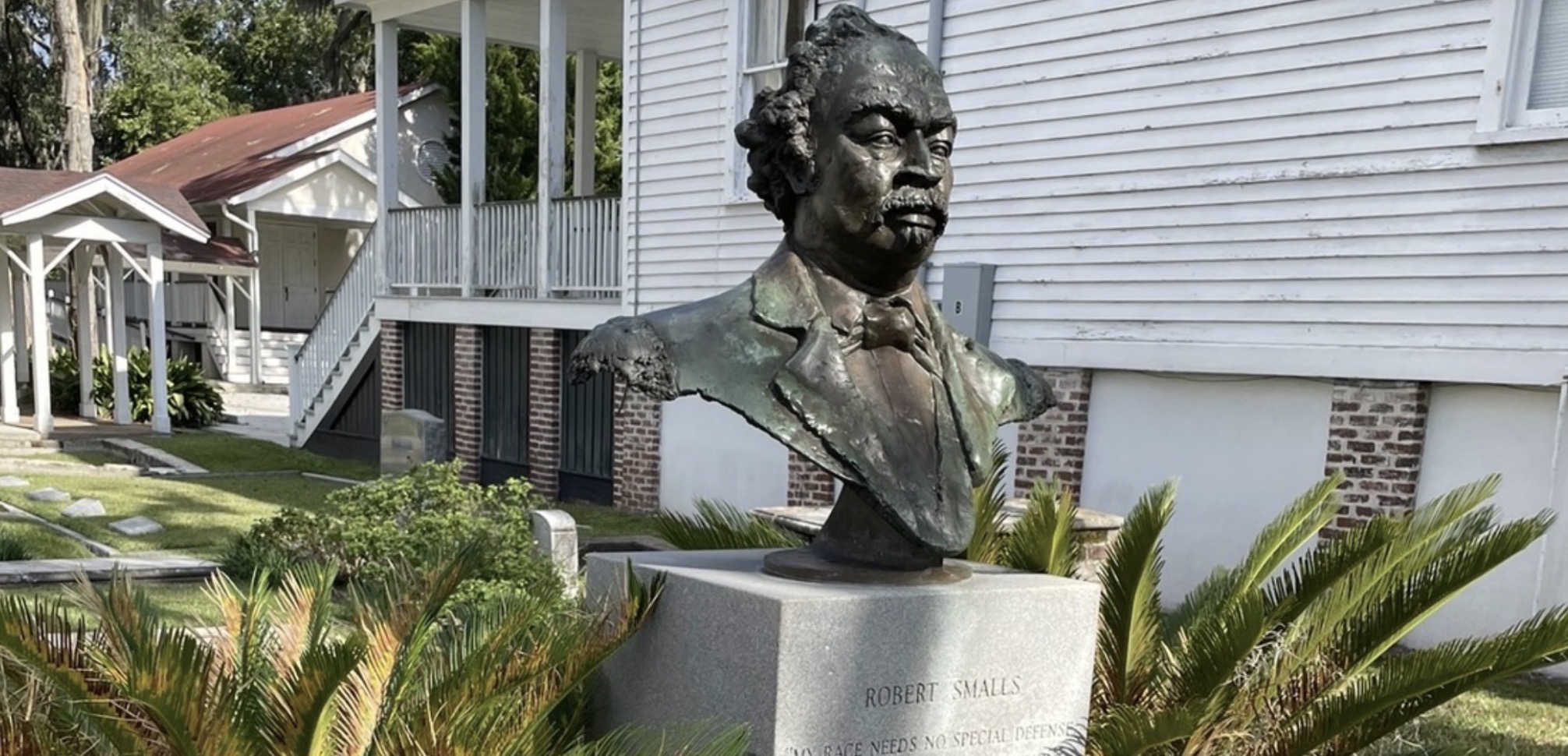
One example of the real Reconstruction was Robert Smalls of Beaufort, South Carolina.
Born enslaved in Beaufort in 1839, Smalls became a skilled harbor pilot in Charleston. In May 1862, he commandeered the Confederate transport ship Planter, picked up his family and the families of other Black crewmen, passed the Confederate forts guarding Charleston Harbor, and delivered the ship to the United States Navy.
After the war, Smalls returned to Beaufort, purchased the house in which he had been enslaved, opened a store, and helped establish a school for Black children. He participated in South Carolina’s 1868 constitutional convention, which created a statewide system of free public education, and subsequently served in the state House of Representatives and Senate. In 1874, voters elected him to Congress, where he supported civil rights and federal protection for Black voters.
Smalls did not fit the old textbook portrait of an ignorant freedman manipulated by carpetbaggers. He was a war hero, businessman, landowner, legislator, and experienced political leader. Nor did he disappear when Reconstruction ended. At South Carolina’s 1895 constitutional convention, he fought the effort to disfranchise Black citizens. Outnumbered by White delegates determined to eliminate Black political power, Smalls declared: “My race needs no special defense, for the past history of them in this country proves them to be the equal of any people anywhere. All they need is an equal chance in the battle of life.”
The defeat of Smalls and other Black leaders was not evidence that Reconstruction government had been inherently unworkable. It demonstrated that interracial democracy could not survive when its opponents employed fraud, intimidation, and murder while the federal government gradually withdrew its protection.
By the time Eric Foner published Reconstruction: America’s Unfinished Revolution in 1988, the older interpretation had largely collapsed among professional historians.
Reconstruction was no longer understood principally as a period of carpetbag corruption and Black incompetence. It was recognized as the nation’s first attempt to establish an interracial democracy—an experiment that produced lasting constitutional achievements but was violently overthrown before its promises could be secured.
The important question therefore changed. Instead of asking why Reconstruction failed, historians began asking who destroyed it, how they did so, and why the nation allowed them to succeed.
In 2022, the online magazine Facing South reported on a Zinn Education Project study of how state standards treated Reconstruction. Using its own grading system, the project gave eighteen states a score of zero and found that only Massachusetts directly connected White supremacy to the Ku Klux Klan, Black Codes, Jim Crow, and Reconstruction’s downfall.
Reconstruction was not a tragic mistake imposed on the South by congressional radicals. The tragedy was that the nation allowed White violence to destroy interracial democracy—and then allowed its destroyers to write the history.
Caption for featured photo
Civil War hero and Reconstruction leader Robert Smalls is remembered with a bust near his grave at Tabernacle Baptist Church in his hometown of Beaufort, South Carolina. Beaufort is also home to the Reconstruction Era National Historical Park. (Author photo)
“Reconstruction was a noble if flawed experiment, the first attempt to introduce a genuine interracial democracy in the United States.”
—Eric Foner, author of Reconstruction: America’s Unfinished Revolution
Leave a Reply