The short answer is yes, but the story is complicated.
For generations, American schoolchildren learned about the westward movement as an almost inevitable procession: pioneers crossed the Appalachians, a heroic Daniel Boone opened Kentucky, settlers moved into Ohio, and wagon trains packed with brave families crossed the Plains.
Indians were usually in the story, but mostly as fierce combatants. Many children learned history through TV shows like Davy Crockett; in the 1950s, I proudly wore a coonskin hat as I conquered the hills looking for bears and “injuns” around my boyhood home in Bethel Park, Pennsylvania.
Did I get the story right?
Start with Ohio.
After the Revolution, the United States claimed the Northwest Territory because Britain ceded it in the Treaty of Paris. There was an obvious problem: the Indians who lived there had not ceded anything. The new government desperately wanted their land. It owed enormous Revolutionary War debts and hoped to acquire Indian territory cheaply and resell it to settlers and land companies.
In 1791, a confederation led by Miami chief Little Turtle and Shawnee chief Blue Jacket annihilated an American army commanded by Arthur St. Clair at present-day Fort Recovery, Ohio. It remains one of the worst defeats the United States Army has ever suffered—and one almost completely missing from popular American memory.
The United States quickly returned with a more determined, better-armed, and better-trained army. In 1794, General Anthony Wayne defeated the tribal confederation at Fallen Timbers, near present-day Toledo. The Treaty of Greenville followed the next year.
Was that land “purchased”? Technically, much of it was.
But calling the transaction voluntary requires ignoring the army that had just trounced the “sellers.”
That pattern continued.
Thomas Jefferson envisioned Indians either assimilating or moving beyond the Mississippi. His administration acquired nearly 200,000 square miles of Indian territory in nine future states, sometimes using debt as leverage, or alcohol as an inducement, to acquire vast tracts from tribal leaders who at times enriched themselves without authority from their members.
Ownership of land presented another complication. Native nations possessed well-understood territorial rights, but their concepts of possession did not correspond to European ideas such as legal title. Territories were often contested, shared, or frequently changed hands through tribal warfare. American leaders such as Indiana governor and future president William Henry Harrison eagerly exploited these ambiguities, negotiating questionable treaties with selected chiefs whose authority to surrender land was sometimes disputed.
In the South, the Creeks lost millions of acres through warfare, coercive treaties, and relentless White settlement. The Cherokees present an even harder case for the traditional story. They adopted many of the institutions White Americans claimed Indians lacked: farms, a written constitution, a newspaper, and a government. They fought removal through the American legal system.
It didn’t work.
After Congress passed the Indian Removal Act in 1830, the federal government ultimately forced thousands of Cherokees west on the Trail of Tears. Other southeastern nations—including the Choctaw, Chickasaw, Creek, and Seminole—were also dispossessed.
And removal didn’t end the conflict. The supposedly permanent Indian country west of the Mississippi became desirable too.
The pattern moved onto the Great Plains and into the West: treaties established Native territory; settlers, miners, or railroads wanted it; Washington changed the boundaries; resistance produced warfare; and military defeat produced another treaty and a smaller reservation.
The United States recognized the Black Hills as part of the Great Sioux Reservation in the 1868 Treaty of Fort Laramie. Gold was discovered. Miners poured in. The government failed to keep them out. War followed, including Custer’s defeat at Little Bighorn. Congress eventually took the Black Hills.
More than a century later, the Supreme Court concluded that the government had taken the land illegally and awarded compensation. The Sioux have largely refused the money. They want the land.
What did we teach children?
For much of the twentieth century, we converted the violent contest over land into the uplifting story of Manifest Destiny. It was Americans’ right—and even duty—as Anglo-Saxon Christians to take the land.
There has been improvement.
The Smithsonian’s National Museum of the American Indian created Native Knowledge 360°, explicitly designed to replace incomplete or inaccurate classroom narratives with material incorporating Native perspectives. Its current elementary-school materials include the Trail of Tears, Little Bighorn, and the question of whether Indian treaties were supposed to last forever. It is not clear to what extent the materials are actually used.
The National Park Service changed too. At Whitman Mission in Washington, the old story centered on missionaries murdered by Indians. Beginning in the late twentieth century, interpretation increasingly explained the Cayuse and Walla Walla world in which those killings occurred. In 2007, the Park Service opened Sand Creek Massacre National Historic Site in Colorado, commemorating the 1864 slaughter of more than 150 Cheyenne and Arapaho, many of them women and children.
That represents more complete history, not anti-American history.
Recently, the pendulum swung back.
In March 2025, President Donald Trump ordered federal historical institutions to eliminate what his administration called “divisive” or “anti-American” interpretations. The order directed the Interior Department to ensure that national parks did not contain descriptions that “inappropriately disparage Americans” and instead emphasized American achievements and progress.
The Smithsonian came under similar pressure. The White House ordered a review of its exhibits, including those at the National Museum of the American Indian. In July 2026, Trump issued another order asserting that the Smithsonian had failed to present American history as “a shared national inheritance” and directing federal officials to use available authority to encourage changes.
The confiscation of Indian land created enormous public and private wealth in the United States. The government gave or sold former Native territory to railroads, homesteaders, ranchers, mining and timber companies, and town developers. Weyerhaeuser built its timber empire on 900,000 acres purchased from the Northern Pacific Railroad’s federally subsidized land grant. Even many of the nation’s greatest universities were founded, financed, or transformed by Indian land sales, including MIT, Cornell, Purdue, Auburn, and the University of California system.
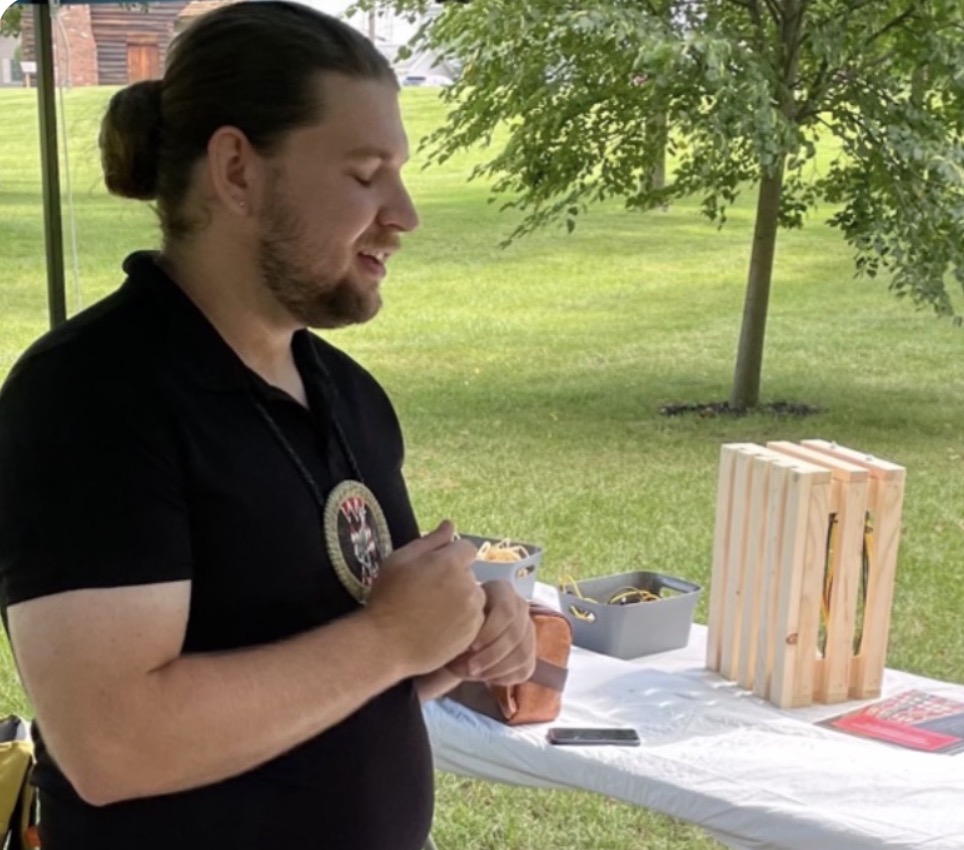
Meanwhile, many descendants of Native peoples are reclaiming their heritage. At a 2023 remembrance of St. Clair’s Defeat, descendants of the Miami people demonstrated traditional crafts. Some were students participating in programs supported by the Myaamia Center, a joint project of the Miami Tribe of Oklahoma and Miami University in Oxford, Ohio. The university, which was named for the tribe, now calls its teams the RedHawks rather than the Redskins.
At Passanageset Park at Broad Meadows Marsh in Quincy, Massachusetts, local students helped recover the nearly forgotten Indigenous history of the marshland. Passanageset had been a seasonal home of the Massachusett people and a seat of Chickatawbut, their principal sachem when the English arrived. After restoration, the park was formally given back its historic name, and interpretive signs now tell visitors about the people who lived there before Quincy existed.
Ren Green, medicine sachem of the Massachusett Tribe at Ponkapoag, participated in that effort. Her comments to me, paraphrased here, may provide an answer to the question of how we should remember our past:
At the very least, we need to protect our memory.
Caption for featured photograph
Jared Nally studies Native textiles at the Myaamia Center, a joint project of the Miami Tribe of Oklahoma and Miami University in Oxford, Ohio. He is shown at a remembrance of St. Clair’s Defeat in Fort Recovery, Ohio. (Author photo)
The story of the Pilgrims and precolonial Indigenous people will be explored in the tenth and final installment of the WHITEWASH series.
For more information, see “Mainfest Destiny and the Battle for Ohio” in the book Turning Points.
“You consider yourselves as independent people; we, as the original inhabitants of this country, and sovereigns of the soil, look upon ourselves as equally independent, and free as any other nation or nations.”
—Thayendanegea, a Mohawk leader, to Henry Knox, secretary of war
Leave a Reply