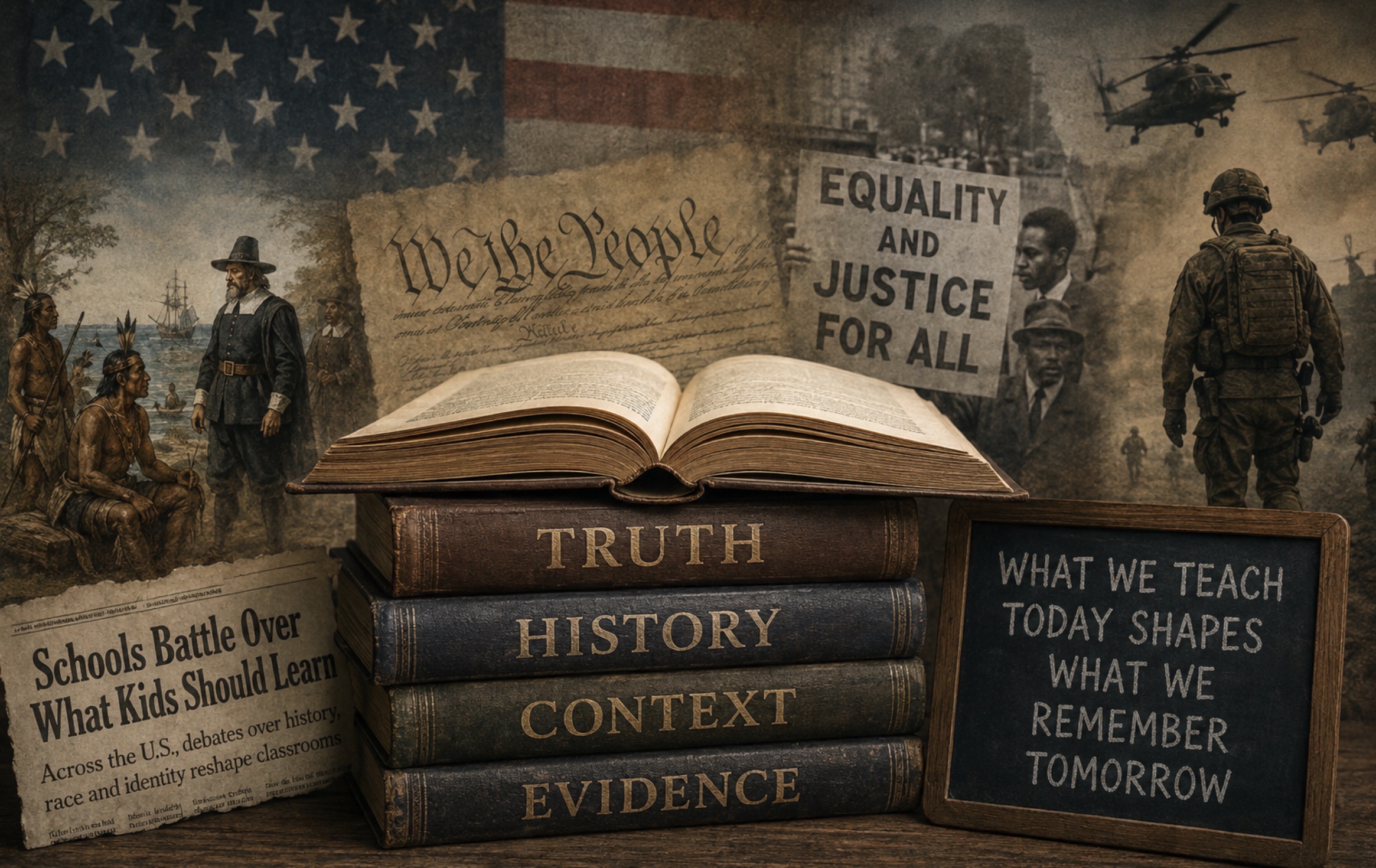
The teaching of American history—whether in schools or through museums such as the Smithsonian—is under attack, caught in one of the most intense battles in decades over how we tell our national story.
In March 2025, President Donald Trump issued an executive order titled “Restoring Truth and Sanity to American History.” Trump argued that institutions such as the Smithsonian placed too much emphasis on the darker parts of our past and too little on American achievement and the greatness of American ideals. His administration has called for the removal of what it considers “divisive” and “anti-American” interpretations of history.
The battle extends far beyond Washington. States across the country have fought over what schools should teach about slavery, race, the Civil War, religion, and American identity. Texas adopted major new social-studies standards in June, although revisions to several high-school courses, including U.S. History, remain under consideration. Florida has increasingly prescribed how history should be framed and what interpretations are permissible through measures such as the Stop WOKE Act of 2022. The Florida Department of Education in 2023 rejected the pilot AP African American Studies course. The College Board subsequently revised the course, removing or making optional some subjects Florida had criticized, although the College Board denied that Florida’s objections caused those changes.
It is important that we teach American history honestly and accurately, even when the truth is not flattering. To become a better country, we need to own our errors and do better—whether that means understanding our troubled racial past or recognizing our repeated tendency to employ overwhelming military firepower without adequately considering the political endgame.
Deliberately distorting history can also worsen racial and political divisions and allow political movements to exploit a distorted version of the past.
Emphasizing American greatness while omitting darker episodes can encourage the dangerous belief that because we are exceptional, we have a special right—or obligation—to impose our values on others. In the nineteenth century, that belief found expression in Manifest Destiny as the United States provoked a war with Mexico that ended with the acquisition of California and much of the Southwest. In 2003, President George W. Bush did not simply argue that Saddam Hussein posed a threat; he told the United Nations that a successful democratic Iraq would demonstrate throughout the Middle East that “freedom, equality, and material progress are possible” and that Iraq as a democracy could “inspire the Middle East.”
I write this as an American who takes great pride in my country and who is saddened by increasing attempts to whitewash our past. Patriotism does not require pretending that our country has always lived up to its ideals. In fact, understanding the occasions when we failed to do so can make those ideals more meaningful. I acknowledge that some people will argue that my views are just as partisan as those espoused by Donald Trump or Florida Governor Ron DeSantis. My approach to history begins with evidence, particularly primary sources left by people who witnessed or participated in the events I describe. Primary sources are not infallible. Witnesses disagree, memories fade, and participants have their own prejudices and interests. But there is a factual foundation to history. The debate comes in deciding what those facts mean, which ones matter most, and what conclusions we should draw from them. I try to base my judgments and interpretations on the historical evidence rather than begin with a political conclusion and select the evidence to support it.
Over the coming weeks, I am going to examine what I consider some of the most serious failures in the way we understand and teach our past. I will follow this introductory post with a detailed look at each. The treatment of Black history, in my opinion, is our single greatest failure. Black Americans were enslaved, lynched, segregated, and marginalized—and then much of their history was ignored, distorted, or erased. Discussing fatal, deceptive attacks by Plymouth colonists in 1623, a leader of the Massachusetts Tribe told me, “At the very least, we do not want our history to be erased.”
I will finish the series on a different note—with inspiring stories that deserve to be better known, such as those of the brave young women who traveled to coastal South Carolina during the Civil War to establish schools for newly freed Black children.
How We Remember American History:
Ten Areas of Potential Improvement
- Was the Constitution Really “We the People”?
- Black History in America
- Did the United States Steal the Southwest?
- When Did America Become an Empire?
- How Did the Indians Lose Their Land?
- Civil War Myths and Distortions
- Did Reconstruction Fail—or Was It Destroyed?
- Must Our Heroes Be Perfect People?
- From Korea to Iran: America’s Misunderstanding of Firepower
- The Pilgrims: Founders or Conquerors?
Leave a Reply