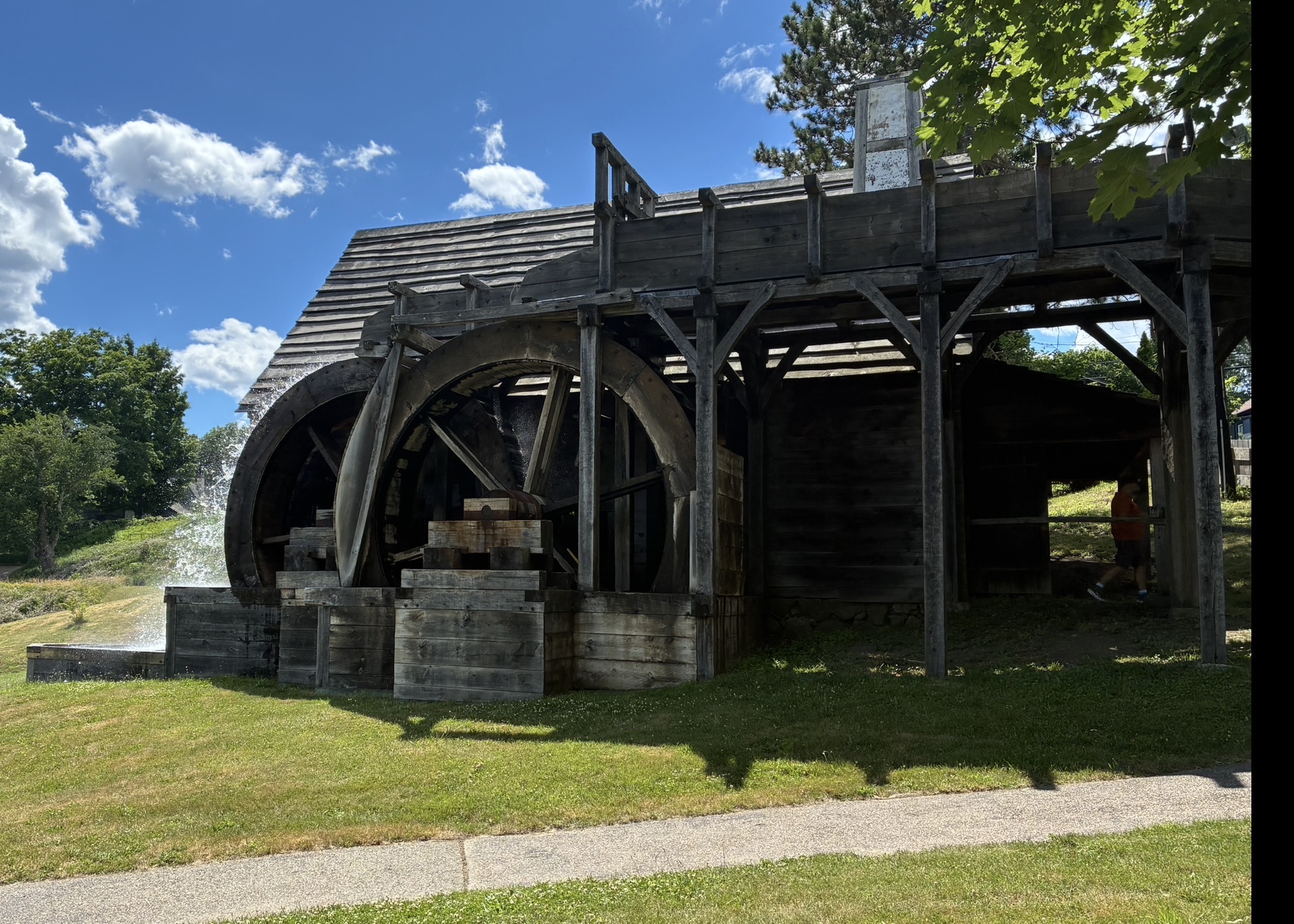
One of the best places—arguably the best—in the world to see a reconstruction of a fully integrated 17th-century iron-manufacturing complex is in Saugus, Massachusetts, where early Puritan leaders were anxious to develop domestic supply.
It is an amazing place to visit, particularly on days when the National Park Service offers guided tours where water turns huge wooden wheels.
The site includes:
>A blast furnace, where locally mined bog iron was charged with charcoal and gabbro, a local rock used as a flux to extract impurities. The molten cast iron was tapped from the furnace and formed into pig and sow bars for further processing or poured directly into molds to make finished products such as pots, kettles and firebacks.
>A water-powered forge and 500-pound trip hammer. Pig iron from the blast furnace was refined in the forge to produce malleable wrought iron. The operating hammer is one of the most dramatic pieces of machinery demonstrated at Saugus.
>A rolling mill, where heated merchant bars passed between heavy iron rollers that squeezed them into thinner, flat pieces. This flat stock was used to make wagon tires and saw blades.
>A slitting mill, consisting of interlocking iron discs rotating in opposite directions. The machinery sliced reheated flat iron lengthwise into narrow rods used primarily for making nails. When the original Saugus rolling and slitting mill was built, there were only about a dozen such mills in the world, all the others in Europe.
Perhaps what is most remarkable about Saugus, however, is the fact that it exists.
Its improbable development coincided with the extraordinary prosperity and dominance of the American steel industry following World War II. American mills had emerged from the war intact and enormously productive, while the industries of Germany and Japan had been devastated or severely disrupted. In 1948, the United States produced more than half of the world’s steel.
That same year, a local preservation organization, the First Iron Works Association, hired archaeologist Roland W. Robbins to excavate the Saugus site. His work uncovered foundations, waterways, machinery and thousands of artifacts associated with the original ironworks.
The discoveries attracted the attention of the American Iron and Steel Institute (AISI), representing an industry then near the height of its global power. In 1949, AISI agreed to support reconstruction of the major components of the 17th-century ironworks on their original site.
The project eventually represented an investment of approximately $2 million—roughly $28 million in today’s purchasing power.
The restored Saugus Iron Works opened to the public in 1954 as a private museum. But the circumstances that had made such an ambitious reconstruction possible were eroding. A 1959 nationwide steel strike disrupted American production and pushed American customers toward imported steel. At the same time, new efficient mills in Western Europe and Japan were coming online.
One early indication of the industry’s emerging crisis came in 1962, in a still-famous confrontation between President John F. Kennedy and U.S. Steel chairman Roger Blough over an attempted increase in steel prices.
By 1965, American production had dropped to roughly one-quarter of global steel demand. The AISI withdrew all financial support for Saugus in the early 1960s and donated the site to the National Park Service in 1968. The NPS has since made substantial investments in maintaining and preserving the reconstructed buildings, waterpower system and machinery.
Today Saugus offers an extraordinary opportunity to walk through an early colonial industrial complex and see (and hear) how iron was manufactured nearly four centuries ago.
For more on the difficulties confronting the American steel industry during the Kennedy administration, see Chapter 4 of JFK: Growth Under Fire. For a discussion of a Civil War-era blast furnace that operated on many of the same basic principles as the Saugus furnace, see Chapter 3 of the book Hallowed Ground.
Leave a Reply