It’s hard to believe that a major movie studio recently dramatized the 1755 Battle of the Monongahela, in which Indian warriors from the Great Lakes area ambushed and massacred a British Army. It was one of the worst defeats suffered by the British Army in North America. And to a history nerd like me it was reminiscent of the utter destruction of Roman legions by German “barbarians” in the Battle of the Teutoburg Forest in A.D. 9.
I grew up in a town adjacent to the battle site in present-day North Braddock, Pennsylvania. It was never discussed, in school or anywhere else. I’m also sure it’s not high on the list of British military historians.
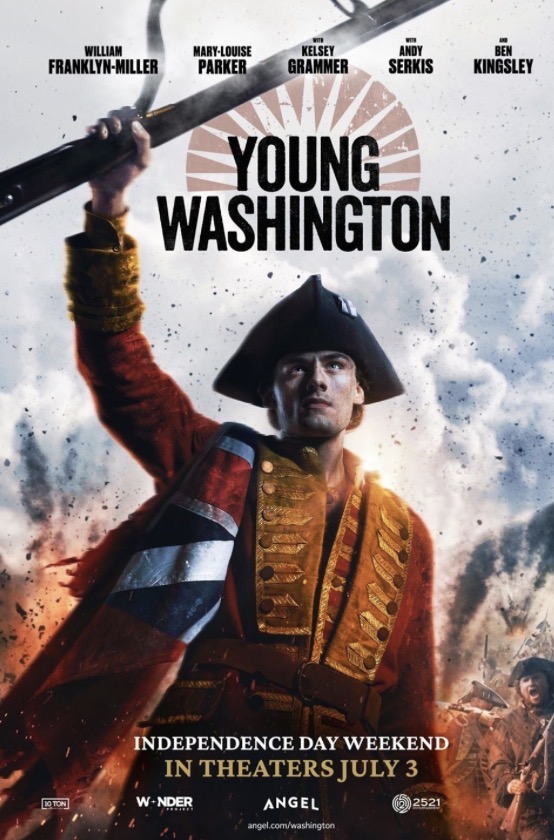
Yet here comes the new movie titled Young Washington, which chronicles George Washington’s ambitious pursuit of military command at the age of twenty, his rejection by the British command, and his reckless exercise of power at Jumonville and Fort Necessity.
Determined to evict the French from the Ohio Country and avenge Washington’s missteps, the British government dispatched respected veteran General Edward Braddock and two regiments of regulars to the frontier west of the Alleghenies. The movie accurately depicts the struggles in building a road through the mountains. Braddock’s troops are accompanied by Washington, who is a volunteer member of the command staff. The troops are also reinforced with Virginia militia.
But it goes off the rails after a “flying column” of the army crosses the Monongahela River about ten miles from the lightly manned, but recently reinforced, French Fort Duquesne.
Washington is shown lying in a near comatose state in a covered wagon and then racing to the front at the sound of cannon fire. He charges to and fro trying to rally troops while facing French artillery fire.
Well, actually Washington remained close to Braddock during the battle and helped remove the general after he suffered wounds that proved mortal. Also, the French did not have any artillery; the British had a few small brass pieces. Oh, and Washington was shown facing fire from French infantry when, in fact, the sustained fire on both flanks came from Indians who took cover in a ravine and behind trees. Most of the British casualties probably were caused by “friendly fire” in the utter chaos and shock of the ambush on the forested hillside.
Washington’s actual role in the battle required no glorification.
By all accounts, he stayed calm in the maelstrom and provided meaningful advice to Braddock, who had no experience in frontier warfare. For example, Washington requested permission to lead the mounted Virginia militia into the forest to rout out Indian snipers. Braddock refused. But it’s very possible that Washington’s advice could have stopped the massacre.
The movie was made by Angel Studios, which began with the commendable idea of providing an alternative to the violent movies made by Hollywood. More recently it seems to have steered into a mission to produce a particular worldview. Washington, for example, is virtually deified at the end of the movie. He is honored as a future great leader by Indian chiefs in a made-up scene. German pastor Dietrich Bonhoeffer gets similar treatment in an Angel movie on his life.
Moviemakers, of course, have always taken great liberty with historical accuracy. Previously, though, this has been done for dramatic effect to sell tickets. In Angel’s case, however, it feels different. It feels like facts are altered to promote a particular view of American history that fits a political worldview.
Leave a Reply